
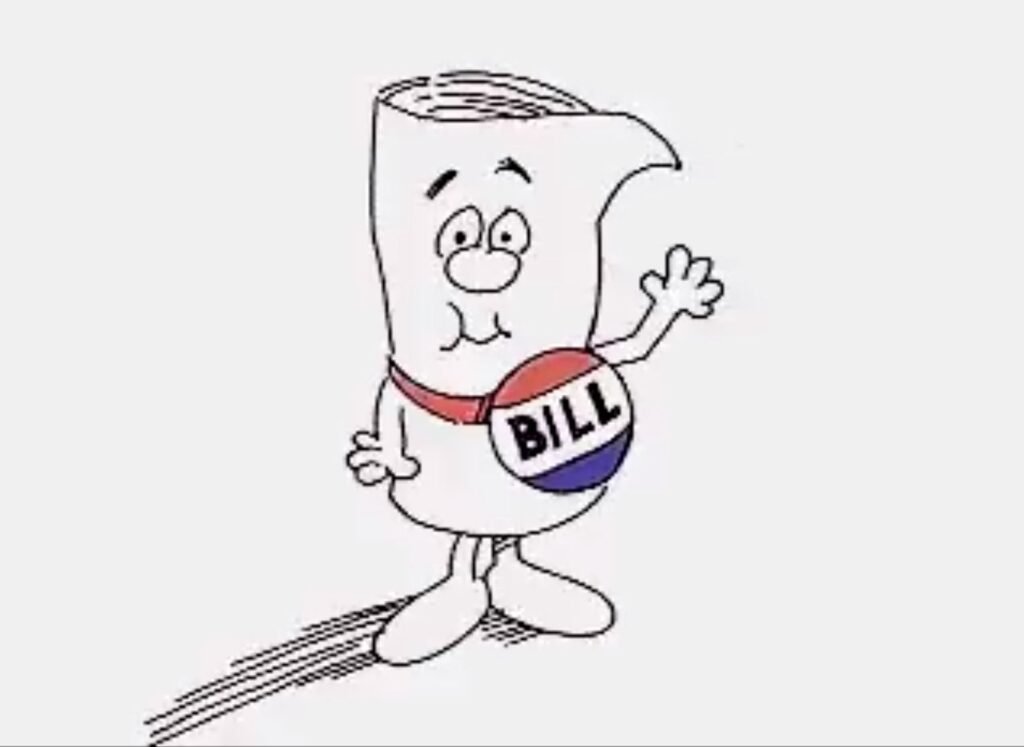
Does this song immediately have you humming along to the Schoolhouse Rock song? It came out in 1973 and still sticks in many of our minds. A link follows if you want a quick refresh on how things work in Washington… or at least how they are supposed to work!
There are some similarities to how a bill is created and processed in the Nebraska Capitol Building in Lincoln, but there are also some clear differences. Follow along and I’ll give you a quick tour on what it takes to make a law here in our great state.
- First, an idea is created by a citizen, constituent, Senator, or a concerned party to change an existing statute with the idea that it becomes part of the NRS, or Nebraska Revised Statutes. There are very few “new laws” that are created, and those would typically require a Constitutional Amendment to be voted on by you and me. All others, including ballot initiatives, are revisions to current statutes.
- A Senator (in Nebraska, your representatives are all referred to as Senators, as there is only one house, our Unicameral) puts some structure on that idea, works with their staff and with Bill Drafting to formulate the actual language. Bill Drafting provides that to the Senator, who signs three copies and submits them to the Clerk during open session. The Clerk’s office assigns a number to it, and it officially becomes a Legislative Bill, or as we usually say, an “LB.”
- Each bill goes before the Referencing Committee, which assigns it to a specific committee, of which there are fourteen. Some you may have heard of are Appropriations, Agriculture, Revenue, Education, and others.
- In Nebraska, EVERY bill receives a hearing which is different than most other states. The committee to which a bill has been assigned schedules a public hearing where anyone can testify as to their thoughts, either pro or con, regarding what that bill would accomplish. These hearings go on for 8–12 weeks, depending on the length of our session that year. Some hearings take 15–30 minutes. Others… well, sometimes they take all day and into the evening. On particularly controversial or emotional issues, some hearings have started in the morning and ended at nearly midnight. Again, every interested citizen has the right to speak at a hearing, and we stay until they are done.
- After a bill is heard by committee, the chair may choose to hold an Executive Session where the bill is discussed amongst members of that committee. These are often very frank discussions about the viability of a bill, its impact, and each Senator’s opinions about whether it moves to the floor for debate or not. Like Washington, a bill can die in committee. It is up to the committee chair whether to hold a vote to advance the bill, and if that vote is held and it is affirmed by the majority of the members, it goes to the floor for full debate.
- Now the bill is on “General File,” which is the first round of debate. Sometimes this can go for up to eight hours before a vote is held. Often, amendments are offered by other Senators, which may either strengthen or weaken the bill. An amendment must have some relativity to the bill, or it will not be allowed for a vote, but there is some judgment and flexibility that occurs there.
- Note One: General File is where we sometimes find out where opposition lies on a specific issue or feature of a bill. If all parties keep their heads and act reasonably, it may also be used as a time to actually improve a bill and make it passable. Often, a Senator will say, “I’ll vote to pass this on General File, with the understanding that problem XXX with the bill will be worked out before it comes back on Select File.”
- Sub Note One: This becomes fodder at times for political ads, as you’ll hear an ad that says “Senator John Doe voted for this evil, radical, or self-serving idea, and you should never support him/her again,” when in reality, Senator Doe voted to allow the bill to become something better. It’s a fine detail, but critically important.
- Note One: General File is where we sometimes find out where opposition lies on a specific issue or feature of a bill. If all parties keep their heads and act reasonably, it may also be used as a time to actually improve a bill and make it passable. Often, a Senator will say, “I’ll vote to pass this on General File, with the understanding that problem XXX with the bill will be worked out before it comes back on Select File.”
- If a bill is filibustered, or taken to the full limit on debate, it may require a cloture vote to advance. A cloture vote requires two-thirds of the 49 members to vote affirmatively, vs. a normal vote, which is a simple majority. This is a critical differentiator, as it is much easier to get 25 votes than it is 33. Requiring cloture via a filibuster is a strategy that is often used to kill a bill that may not be liked by some and is used by all members at times.
- If a bill passes on General File, it goes to “Select File” Debate, which is the same routine, except only half the time is allowed for debate. Again, amendments are likely to be offered, some friendly, some hostile. Some will become a part of the bill, some won’t. Again, cloture may be required.
- If a bill passes on Select File, it goes to “Final Reading”. This is one of those bizarre rule requirements where the bill, or much of it, must be read aloud by the clerk to the body before voting on it. Sometimes there is debate on Final Reading, but often the problems are worked out, and a bill that may have narrowly passed the two previous rounds of debate will pass with a clear majority, simply because it had the chance to be made better.
- So you think that bill is done now? NO! Just like the Schoolhouse Rock song points out, every bill is subject to veto. The Governor may intentionally veto a bill, which sends it back to us for another round of debate to possibly override, or they can “pocket veto” a bill, which simply means they do not sign the bill and it becomes law without the Governor’s endorsement.
- Most bills become law three calendar months after the session adjourns, unless they have a clause that states otherwise.
Whew, that’s a very quick summary of what we do in Lincoln from January to June in the long, ninety-day session, and through April in the shorter sixty-day session. Only in government can ninety days take six months to complete as only the days we are gaveled-in are considered session days.
The process can be confusing, and there is definitely a learning curve to understanding all of the rules of debate and process. If you have questions about how all of this works, don’t hesitate to reach out to me for additional clarity. I can be reached at brad.vongillern@leg.ne.gov.